How to Prioritize Tasks With a Priority Matrix
Use a four-quadrant priority matrix to separate urgent work, important long-term work, delegable tasks, and low-value activity.
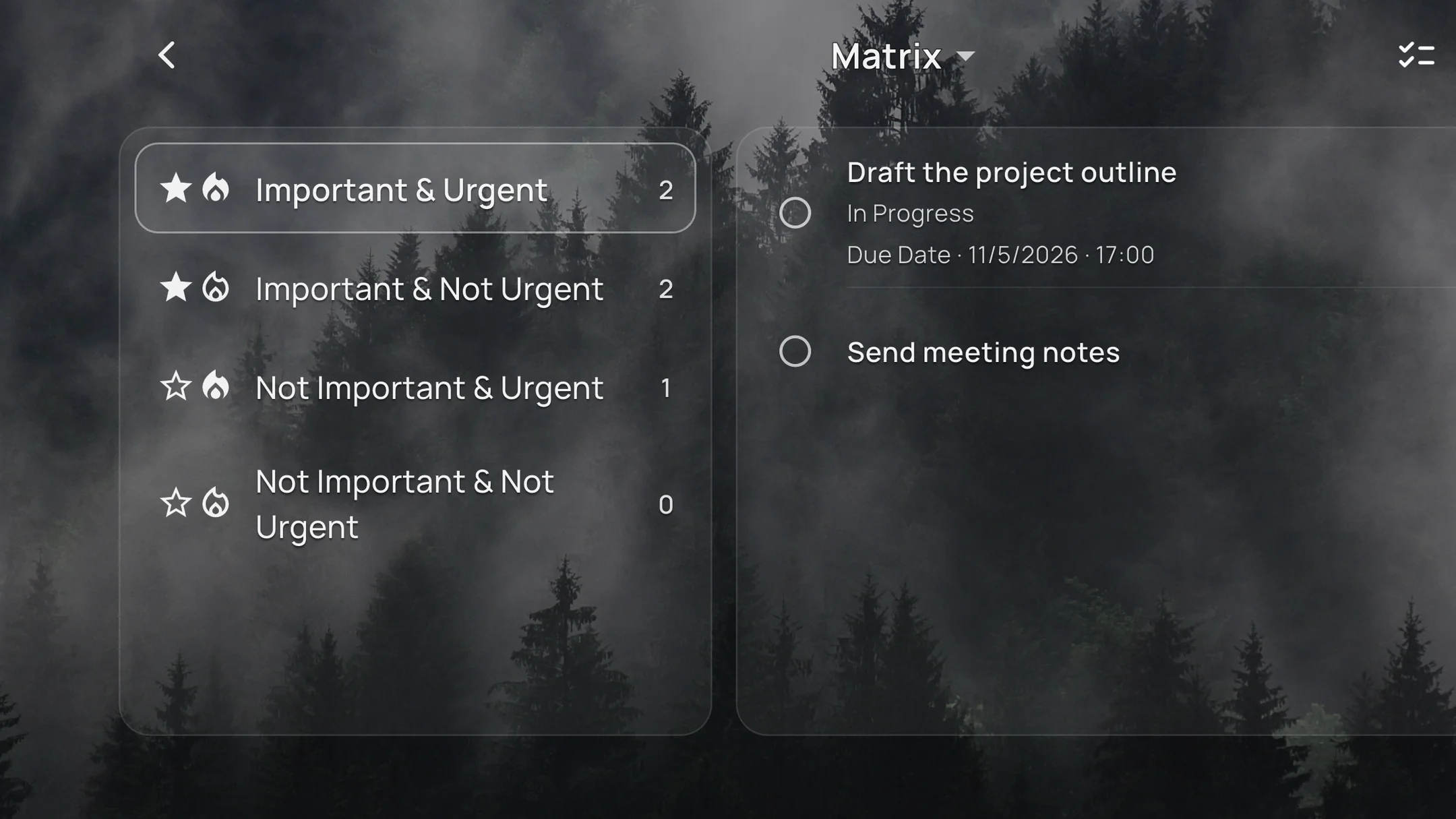
A priority matrix separates tasks by urgency and importance. Its main value is not the four boxes themselves; it is the decision process that prevents every request from appearing equally important.
Define urgency and importance
Urgent tasks have a near-term consequence or deadline. Important tasks contribute meaningfully to goals, responsibilities, or risk reduction. A task can be important without being urgent.
Place urgent and important work first
Examples include imminent deadlines, critical problems, and necessary responses. Define the next action and protect focused time for completion. Avoid letting preventable tasks remain here every week.
Schedule important but not urgent work
This quadrant includes planning, learning, maintenance, and long-term projects. Assign calendar blocks before urgent work consumes the week. Regular attention here reduces future crises.
Delegate or simplify urgent but less important work
Some requests require a response but not your full attention. Use templates, batching, or delegation when appropriate. Do not confuse another person’s urgency with your highest priority automatically.
Reduce low-value work
Identify tasks that are neither important nor time-sensitive. Delete, limit, or postpone them deliberately. Be careful: rest and relationships are not automatically low-value just because they are not urgent.
Turn quadrants into action
Choose one task from the first quadrant and one scheduled task from the second. Assign a clear next step and a realistic focus block. Review the matrix weekly because urgency changes over time.
Worked example and adjustment
Suppose you have an assignment due tomorrow, exam revision for next week, a nonessential request marked urgent, and an optional feed to browse. Submit the assignment, reserve revision time, negotiate the request, and drop the feed. When two tasks share a quadrant, compare consequences and dependencies; the boxes do not make that decision for you.
Frequently Asked Questions
Is everything with a deadline urgent?
Not immediately. A distant deadline may be important but not yet urgent.
Where does rest belong?
Rest can be important maintenance even when it is not urgent.
How often should I update the matrix?
Briefly each day and more fully once a week is a practical rhythm.
Sources and limits
- Zhu, Yang & Hsee (2018). The Mere Urgency Effect. Journal of Consumer Research.
Experiments found that artificial urgency could favour lower-payoff choices. They did not validate the four-quadrant matrix.